
Data centres in France: value lies in deliverable megawatts
A well-located plot and an announced power capacity are a starting point. The decisive question is how much capacity can actually be brought into service, when, at what cost and on what conditions.
What the launch of the Ozans consultation tells us about project development
The Blob Company — Analysis dated 2 November 2026
A well-located plot and an announced power capacity are a starting point. For an operator or investor, the decisive question remains: how much capacity can actually be brought into service, when, at what cost and on what conditions?
The launch of the consultation on Google’s proposed Ozans development offers a timely illustration. It invites us to assess data centres as phased industrial programmes, in which land, grid infrastructure, approvals and customer requirements must progress together.
The news: a development planned in phases
According to RTE, the preliminary public consultation on Google’s proposed development in the Ozans development zone, in Étrechet, Indre, runs from 2 November 2026 to 10 January 2027. It also covers the electricity connection. An initial phase envisages one building around 2030, supplied through a 225 kV connection with a capacity of 120 MW. A second phase includes connection infrastructure at 400 kV. The site could eventually accommodate six to eight buildings over ten to twenty years. The proposal remains subject to consultation, and these timeframes are not delivery guarantees. [1] The official project overview confirms the initial 120 MW connection at 225 kV and the phased approach of six to eight buildings over ten to twenty years. [5]
The consultation itself follows a decision of 1 April 2026 by the Commission nationale du débat public (CNDP), the independent national public debate authority, to organise a preliminary consultation. This is a public participation framework. It does not grant planning permission. [6]
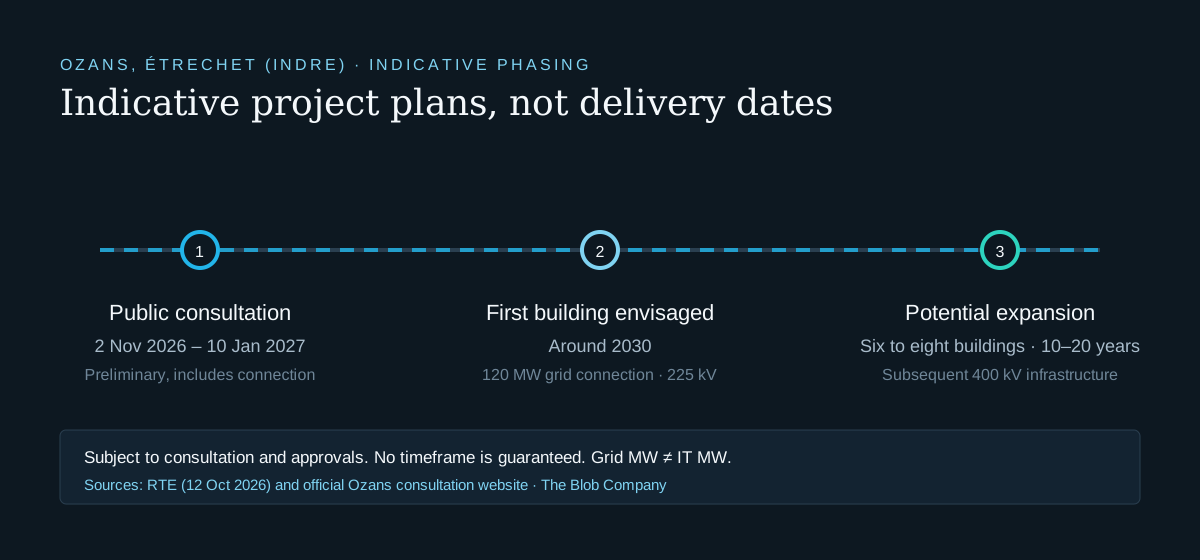
Our assessment: presenting a development in phases is essential. It allows the initial investment and the conditions for expansion to be assessed separately. Ultimate capacity should never obscure the constraints affecting the first phase.
A global trend does not validate an individual site
The projection: in its 2026 update, the International Energy Agency projects worldwide data centre electricity consumption rising from 485 TWh in 2025 to around 950 TWh in 2030, roughly 3% of global electricity demand. This is a forecast, not a measured 2030 figure. [7]
The Blob’s view: strong aggregate growth confirms the scale of demand. It does not establish the feasibility, timing or economics of any individual site. That still depends on the local evidence discussed below.
A grid connection request is not available IT capacity
RTE reports that, in May 2026, close to 18 GW of capacity had been reserved for approximately 80 projects. These figures describe the position at that date, rather than an updated inventory as of 2 November. RTE also notes that sites connected for two to three years use, on average, approximately 20% of the power they requested. This observation relates to that group of sites. It measures neither their commercial occupancy nor utilisation across all French data centres. [2]
The Blob’s view: commercial presentations should state three separate figures: grid connection capacity, initial-phase IT capacity and potential expansion IT capacity. Reconciling them requires explicit technical assumptions covering efficiency, cooling, auxiliary loads, operating margins and the resilience architecture.
This discipline immediately improves comparisons between opportunities. Two sites advertised with the same number of megawatts may have very different delivery schedules, development costs and commercial prospects.
Proximity to a substation is an indicator, not proof of feasibility
RTE’s documentation distinguishes its exploratory study, which is indicative and does not bind either party, from subsequent connection stages. For “fast-track” sites, the criteria combine suitable land, proximity to the network and the ability to manage congestion. Distance to infrastructure alone therefore cannot establish a viable connection solution. [3]
Our recommended approach: request a power dossier specifying the connection point under consideration, capacity in each phase, required works, potential restrictions, costs and milestones. Open assumptions should have a named owner and a date for the next clarification.
The connection timetable must also be distinguished from the data centre’s operational readiness date. Making power available does not, by itself, complete building works, integrated systems testing or customer acceptance.
The local area is part of the development programme
Ozans is a reminder that data centre development also depends on dialogue with local stakeholders. [1] At The Blob, we believe that dialogue deserves the same preparation as the electrical design.
The first question is whether the proposed programme fits the site: layout, access, neighbours, noise, water, risks, ground conditions, utilities and room for expansion. The second concerns the substance of proposed commitments. For example, a heat-recovery ambition becomes more meaningful when supported by an identified heat user, a temperature requirement, a timetable and a clear allocation of responsibilities.
We recommend documenting these interfaces during the initial studies. An untested assumption can readily become a cost or delay discovered too late.
Our view: finance a credible path to delivery
In its report of 16 September 2026, the French Senate noted that even expedited connections can take several years, citing RTE’s indication of three to four years. This benchmark is not a commitment for any individual project. [4]
The Blob’s conviction is straightforward: the quality of an opportunity depends on the credibility of its path to operation. A smaller initial phase, aligned with a customer’s requirements and backed by a documented timetable, may be more compelling than a larger capacity whose delivery conditions remain unresolved.
This requires an economic assessment by phase. The initial phase must account for the shared infrastructure costs it carries. Expansion plans should identify incremental expenditure, investment triggers and schedule risks. A downside case should show the effect of delayed delivery, slower customer take-up and a longer funding requirement. These scenarios are our proposed analytical approach, not forecasts for Google’s project.
Six areas of evidence to assemble before approaching investors
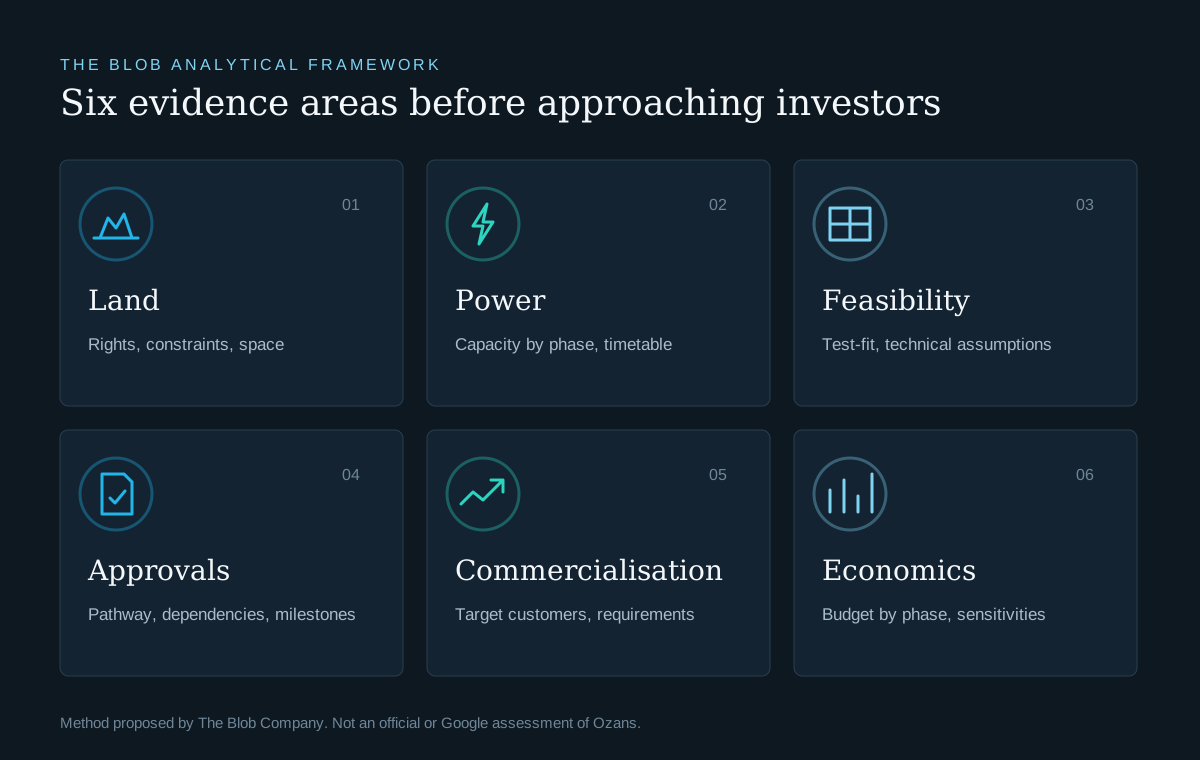
| Area | Evidence expected in the dossier |
|---|---|
| Land | Documented rights, identified constraints and sufficient space for the proposed programme |
| Power | Available studies and documents, capacity by phase, conditions and timetable |
| Feasibility | Test-fit, technical assumptions, ground and utility constraints |
| Approvals | A pathway identified with the relevant advisers, dependencies and milestones |
| Commercialisation | Target customers, technical requirements, decision timetable and level of commitment |
| Economics | Budget by phase, contingencies, cash flow and sensitivity scenarios |
This framework is a method proposed by The Blob. It is neither a rating of Ozans nor a statement about non-public project documents.
A partner network creates value through defined deliverables
An adviser’s coverage map should help clients understand which capabilities they can access. Geographic reach becomes meaningful when linked to a requirement: land prequalification, technical review, design, connection planning or market access.
Our approach is to define the scope, deliverable, accountable party and interfaces with other advisers for each assignment. Local capabilities and availability are confirmed assignment by assignment. Commercial coverage should not be presented as a local office, an exclusive arrangement or a completed project reference.
The Blob Company supports the qualification, structuring and development of data centre and powered land opportunities. Our priority is to make assumptions verifiable and decisions actionable.
Sources and scope
Public sources consulted on 2 November 2026. Facts are attributed to the sources below, the IEA figure is a projection, and the assessments, The Blob viewpoints and recommendations are editorial analysis for The Blob Company. Illustrations are original conceptual graphics by The Blob Company, not images of Google’s project. No mandate or commercial relationship with Google, RTE or the CNDP is implied. Source titles from French publications are translated into English.
- 1.RTE — Preliminary consultation on Google / Ozans, scheduled for 2 November 2026 to 10 January 2027. Published 12 October 2026, accessed 2 November 2026.
- 2.RTE — Key figures on data centres. The capacity figures cited relate to May 2026. Accessed 2 November 2026.
- 3.RTE — Connecting an installation to the public transmission network. Accessed 2 November 2026.
- 4.French Senate — Information report No. 949, submitted on 16 September 2026, section II. Accessed 2 November 2026.
- 5.Ozans data centre consultation (official project website) — The project in brief. Accessed 2 November 2026.
- 6.CNDP — Decision No. 2026/37 on the Google & RTE data centre project, 1 April 2026 (PDF). Accessed 2 November 2026.
- 7.IEA (2026) — Key Questions on Energy and AI, Executive summary. Accessed 2 November 2026.
Apply this analysis to your project
You can engage The Blob Company for site feasibility, power strategy, development leadership and investment review. We can scope a focused review around your next decision.
Related analysis
ING’s Data Centre Loan Sale: Who Pays When Delivery Slips?
A reported $500 million debt sale brings the financing of data centres back to a practical question: what happens to the investment case when power, construction and customer payments fall out of step?
Valuing Data Centre Companies: From Project Delivery to Enterprise Value
A six-step method connecting project management, CAPEX, contracted revenues and valuation multiples, with a worked example and sensitivity analysis.
What to Expect from Data Centre World Paris 2026
France’s data centre opportunity will be delivered through land agreements, grid connections, permits and customers. Here is what to test at Data Centre World Paris 2026 before committing capital.