
ING’s Data Centre Loan Sale: Who Pays When Delivery Slips?
A reported $500 million debt sale brings the financing of data centres back to a practical question: what happens to the investment case when power, construction and customer payments fall out of step?

The phrase “mystery seller” was always going to travel faster than the detail. A portfolio of data centre loans, a $500 million headline and a connection to Stargate make for a compelling story. For anyone developing or financing a campus, though, the interesting part comes after the headline: what are buyers being asked to take on, and what price will they put on it?
According to Bloomberg, the seller is ING. The bank is reportedly seeking bids for around a dozen loans, including exposures to Vantage Data Centers and CyrusOne, and a $25 million position linked to Stargate in New Mexico. Offers are reportedly due on 19 November, with a minimum size of $10 million. ING declined to comment. [1]
At the time of writing, there is no disclosed clearing price or confirmed completed transaction in the reporting reviewed. That leaves plenty of room for interpretation. My interest is in what this process might reveal about the value investors attach to a credible delivery date.
The Stargate position accounts for about 5% of the reported portfolio. The auction concerns loans, not the sale of Stargate itself.
The price will matter more than the announcement
There are perfectly ordinary reasons for a bank to sell loans. It may want to reduce a concentration, release lending capacity or change the balance of its portfolio. It may also have become less comfortable with the risk. We do not know which explanation applies to ING, and the announcement does not resolve that question.
The competitive bidding process gives potential buyers a chance to express a view with money. If transactions follow, their terms may be revealing. An operating facility collecting revenue and a development waiting for power can carry very different risks, even when both sit under the same broad “data centre” label.
I would be careful about drawing conclusions from an aggregate price. A loan’s maturity, interest rate, security and ease of resale all matter. So do remaining funding commitments. A discount to face value can reflect several of these factors without translating directly into an equivalent fall in the value of the building or the borrower’s equity.
For developers, a more consequential signal would be a pattern of comparable loans trading at returns that make new financing harder to obtain on previous terms. This auction is worth watching for that reason. One proposed sale is still too little evidence to call a general retreat from the sector.
Power is where the financing story becomes physical
Stargate attracts attention because of its scale and the names behind it. The New Mexico exposure also brings a familiar development problem into view: a project can have substantial financial backing and still depend on infrastructure that is not yet ready.
In September, Reuters reported that Oracle had sent a force majeure notice to a Blue Owl unit developing Project Jupiter, citing potential delays in securing power. Oracle said at the time that the project remained on schedule. Blue Owl said the notice did not alter the financial commitments to the development. [2]
Those responses belong in the story. The notice alone establishes neither abandonment nor default, and its effect cannot be determined without the underlying agreements.
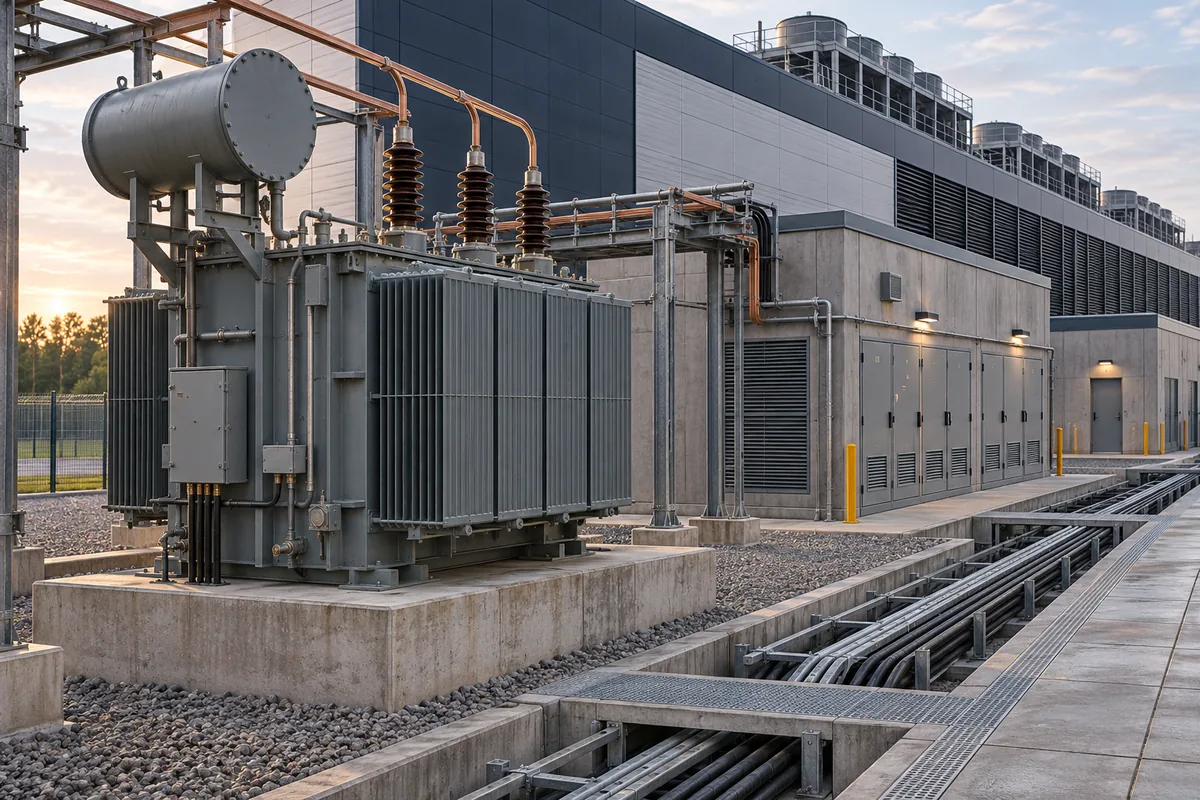
For an investor, the practical issue is the period between spending the money and receiving the expected income. A strong customer is valuable. The dates and conditions attached to that customer’s payments are equally important.
Before relying on contracted revenue in an investment case, I want to understand what starts the payment obligation. Is it a calendar date, the availability of power, completion of a particular phase or the customer’s acceptance of the facility? If part of the campus is ready, can that part earn revenue? If a milestone moves, which costs continue and who carries them?
These questions belong in the early development discussions. By the time the construction programme slips, the allocation of risk may already have been fixed in several different contracts.
Six months can be expensive without a single cancelled contract
A delay does not need to destroy demand to damage a return. It can simply keep capital tied up for longer.
Take an illustrative project with average drawn debt of €200 million at a 7% annual cash interest rate. Extending that exposure for six months adds roughly €7 million of simple interest. A year adds roughly €14 million. The customer could remain committed throughout.
Six additional months. €200 million of average drawn debt. A 7% annual interest rate. Approximately €7 million of extra interest, before other costs.
This calculation is an illustration, not an estimate for ING or Stargate. It excludes fees, compounding, changing drawdowns, hedging and any recoveries. A real model must follow the actual financing terms and the month-by-month programme.
The rest of the cost can be less obvious. A project team stays in place. Insurance and site costs continue. Equipment may need to be stored or maintained before use. Meanwhile, receipts may arrive later than expected. Some income is deferred, some may be affected by contractual provisions, and the distinction changes the result.
Contractual compensation can help, but it must be examined on its own terms. A claim with a cap, an uncertain recovery date or a dispute attached to it is not the same as cash available to pay interest next month.
That is why I want the cost plan, programme and cash-flow model reviewed together. A delay shown in a construction report should appear in the funding forecast before it becomes a cash shortfall.
What I would look for in the project file
“Power secured” is one of the first phrases I would unpack. It can describe very different stages of development. An indication of network availability, a connection offer and an executed agreement do not provide the same evidence. Even a signed agreement needs to be read alongside its conditions, works and delivery dependencies.
The useful discussion is specific. Which upstream works are needed? Who owns the programme? Are the necessary land rights in place? What has been ordered, and what still depends on an approval or a third party? How much capacity can actually be energised at the first delivery date?
The capacity figures also need to reconcile. Connection capacity expressed in MW or MVA should not quietly become IT load in the business plan. Cooling, electrical losses and operating assumptions need to be reflected consistently in the design and revenue model.
A similar exercise applies to permissions. A consent for the main building may leave other essential elements unresolved. Access, electrical infrastructure, fuel supply or environmental conditions can sit on a separate path. The financing case needs to follow all the works required to operate the first phase.

The last stretch deserves attention too. A building can look complete while testing, commissioning and customer acceptance are still ahead. Those activities take time, need people and depend on functioning systems. They should have a realistic place in the programme, with payment assumptions that match the agreed acceptance process.
None of this requires a more elaborate presentation. It requires the documents, responsibilities and dates to agree with one another.
A smaller first phase only helps if it can stand on its own
Phasing is often the sensible response to uncertainty. Build an initial tranche, bring it into service and commit further capital as demand and infrastructure mature. The benefit is real when the first phase can operate independently.
The complication is shared infrastructure. The initial tranche may require much of the ultimate substation, cooling plant or access works. Dividing the campus into equal blocks of megawatts on a slide does not divide its early expenditure equally.
I would therefore work through the minimum infrastructure needed to serve the first customer, the commissioning sequence and the effect of later works on an operating facility. That produces a more useful funding requirement than applying a simple proportion to the total campus budget.
For a European powered-land opportunity, this distinction can materially change the investment discussion. An initial phase supported by executable connection works and a credible route through permissions can be evaluated on its own merits. Expansion capacity then carries the assumptions and conditions appropriate to its maturity.
The US loan auction does not give us a ready-made discount for European land or projects. It does reinforce the case for explaining those differences before an investor has to discover them during due diligence.
Before committing capital, I would want to know who funds a six-month delay and how early the project team would see it coming.
The answer should come from a cash-flow sensitivity tied to the programme. It should show the additional funding requirement, the reserves available and the point at which a decision is needed. A revised sequence, earlier procurement or extra committed liquidity may improve the position. Each has a cost, and that cost can be weighed against the exposure it addresses.
When the reported ING bidding deadline passes, I will be interested in whether the loans sell, whether buyers distinguish sharply between assets and what becomes known about the terms. Until then, treating the announcement as proof of a financing crisis runs ahead of the evidence.
For a developer preparing an investment case today, the work is already clear enough. Put the power documents beside the construction programme. Put the customer’s payment conditions beside the cash-flow forecast. Then work through what happens if the dates move. That is where a project’s ability to attract and retain capital becomes much easier to judge.
Matthieu Gallego — Founder, The Blob Company
The Blob Company advises owners, developers and investors on data centre feasibility, development and investment decisions. Discuss your project or read more about our valuation and investment analysis work.
Reporting and illustrations
1. Bloomberg, republished by The Edge, 6 November 2026. Reporting by Carmen Arroyo, Jeannine Amodeo, Rachel Graf and Olivia Fishlow.
2. Reuters, republished by KSL, 24 September 2026. Reporting by Isla Binnie and Jaspreet Singh.
Analysis dated 6 November 2026. The financing examples and interpretation are The Blob Company’s own analysis. All three images are AI-generated conceptual illustrations, not photographs of the projects discussed.
Apply this analysis to your project
You can engage The Blob Company for site feasibility, power strategy, development leadership and investment review. We can scope a focused review around your next decision.
Related analysis
Valuing Data Centre Companies: From Project Delivery to Enterprise Value
A six-step method connecting project management, CAPEX, contracted revenues and valuation multiples, with a worked example and sensitivity analysis.
Data centres in France: value lies in deliverable megawatts
A well-located plot and an announced power capacity are a starting point. The decisive question is how much capacity can actually be brought into service, when, at what cost and on what conditions.
What to Expect from Data Centre World Paris 2026
France’s data centre opportunity will be delivered through land agreements, grid connections, permits and customers. Here is what to test at Data Centre World Paris 2026 before committing capital.